In the ever-evolving landscape of artificial intelligence, new breakthroughs and innovations continually reshape our understanding of what machines can achieve. One such innovation that has been gaining significant attention is the “Decision Transformer.” This cutting-edge concept has the potential to revolutionize the way AI systems make decisions and promises to bring about advancements in fields ranging from healthcare to finance and beyond. In this article, we will delve into the world of Decision Transformers, exploring what they are, how they work, and their potential applications.
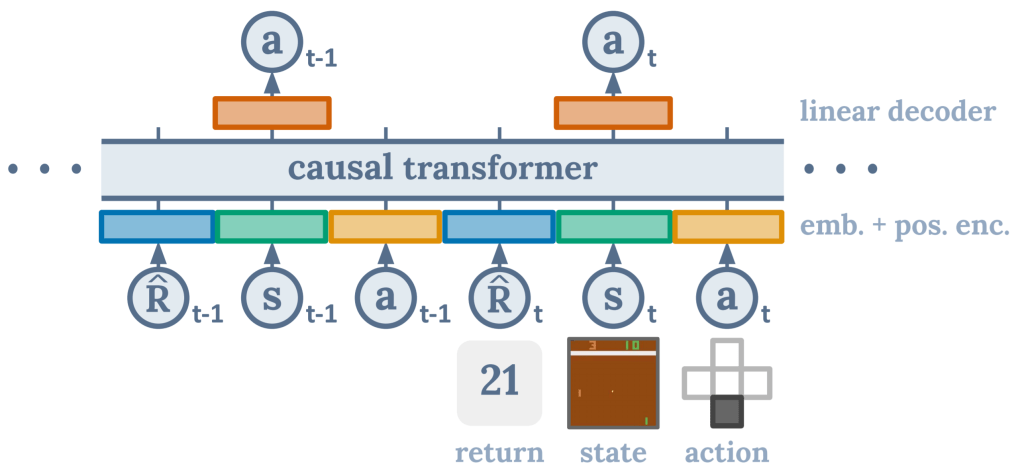
Decoding Decision Transformers
Decision Transformers, often abbreviated as DT, represent a fascinating convergence of two powerful AI technologies: Transformers and Reinforcement Learning (RL). To understand Decision Transformers, we must first grasp these foundational components:
- Transformers: Transformers are a type of neural network architecture that has played a pivotal role in various AI applications, particularly in natural language processing (NLP). Introduced in the groundbreaking paper “Attention is All You Need” by Vaswani et al. in 2017, Transformers utilize a mechanism called self-attention to process and understand sequences of data, making them highly efficient for tasks such as language translation and text generation.
- Reinforcement Learning (RL): Reinforcement Learning is a machine learning paradigm where an agent learns to make decisions by interacting with an environment. The agent receives feedback in the form of rewards or penalties based on its actions and uses this feedback to improve its decision-making over time. RL has found success in a wide range of applications, including game playing, robotics, and autonomous systems.
Bringing Transformers and RL Together
Decision Transformers represent a fusion of these two foundational concepts. They harness the power of Transformers’ sequence processing capabilities and the decision-making prowess of Reinforcement Learning to create AI models capable of making complex decisions across various domains.
At the core of Decision Transformers is the idea of decision-making as a sequence-to-sequence problem. In this framework, the AI model takes a sequence of input data, processes it using self-attention mechanisms, and produces a sequence of output actions or decisions. These decisions are then refined through RL techniques, allowing the model to learn and optimize its decision-making strategies over time.
How Decision Transformers Work
The workings of Decision Transformers can be broken down into several key components:
- Input Encoding: Decision Transformers take in a sequence of input data that represents the current state or context of the decision-making problem. This input is encoded using self-attention mechanisms, allowing the model to focus on relevant information and understand complex relationships within the data.
- Policy Generation: The model generates a sequence of actions or decisions based on the encoded input. These actions could range from selecting a word in a sentence (in NLP tasks) to choosing specific actions in autonomous driving scenarios.
- Reinforcement Learning: The generated actions are then executed in the environment, and the model receives feedback in the form of rewards or penalties based on the outcomes. This feedback is crucial for the model to learn which actions lead to favorable outcomes and which do not.
- Policy Optimization: Through iterative learning and optimization, the Decision Transformer refines its policy for decision-making. Reinforcement Learning algorithms, such as Proximal Policy Optimization (PPO) or Trust Region Policy Optimization (TRPO), are often employed to update the model’s policy.
- Decoding and Output: Once the model has learned an effective decision-making policy, it can generate optimal sequences of actions or decisions in real-world scenarios, providing solutions to a wide range of problems.
Applications of Decision Transformers
The versatility of Decision Transformers opens the door to numerous applications across various domains. Here are some examples of how this emerging technology is making an impact:
- Healthcare: Decision Transformers can assist doctors in diagnosing medical conditions by analyzing patient data and recommending treatment plans. They can also aid in drug discovery and clinical trial optimization.
- Finance: In the financial sector, Decision Transformers can enhance portfolio management, risk assessment, and fraud detection by making informed decisions based on market data and historical trends.
- Autonomous Systems: Decision Transformers can power autonomous vehicles, drones, and robots, enabling them to navigate and make decisions in dynamic environments, such as traffic or disaster response scenarios.
- Natural Language Processing: In NLP, Decision Transformers can improve language translation, text summarization, and chatbot interactions by making context-aware decisions during text generation.
- Gaming: Decision Transformers can revolutionize the gaming industry by creating intelligent non-player characters (NPCs) that adapt their strategies and decision-making in response to player actions.
Challenges and Future Directions
While Decision Transformers hold immense promise, there are several challenges that researchers and developers must address as they continue to advance this technology. These challenges include:
- Data Efficiency: Training Decision Transformers often requires a large amount of data and computational resources, making it necessary to explore techniques for more data-efficient learning.
- Interpretability: Understanding the decision-making process of AI models like Decision Transformers is crucial, especially in critical applications like healthcare, where transparency and interpretability are paramount.
- Safety and Ethics: As AI systems become more capable, ensuring their ethical and safe deployment becomes increasingly important. Ethical considerations and safeguards against biased decision-making are essential.
- Real-time Decision-making: Some applications, such as autonomous driving, require decisions to be made in real-time. Achieving low-latency decision-making without compromising accuracy is a significant challenge.
In conclusion, Decision Transformers represent a promising frontier in the world of artificial intelligence. By combining the strengths of Transformers and Reinforcement Learning, these models have the potential to revolutionize decision-making processes across a wide range of domains. As researchers continue to refine and develop this technology, we can anticipate a future where AI systems make decisions that are not only intelligent but also ethical and transparent, ushering in a new era of AI-driven decision support.

